StenchillBeta
Your PCB stencil, 3D printed
Upload your Gerber files, get a 3D-printable file in seconds.
How it works
Upload
Your Gerber ZIP file (KiCad, Eagle, Altium export...)
Preview
View the stencil in 3D and adjust settings if needed
Download the STL or 3MF file and print it on your 3D printer
Barbatronic uses Stenchill
Barbatronic is a French maker and robotics creator. On Twitch since 2019, he publishes hardware tutorials on YouTube, runs an active Discord community, and is a member of the Karibous team, which competes every year at the French Robotics Cup. A community of curious hackers and hands-on makers shows up each week for his practical hardware insights.
Stenchill was actually born in one of his streams. A chat discussion convinced me the idea was worth building and that I had the skills to ship it.
In this video, he integrates Stenchill into his fabrication workflow and shares his first impressions.
What is a stencil?
A stencil is a thin plate with openings matching the solder pads on your PCB. Place it on the board, spread solder paste with a squeegee, then position your SMD components before reflow. The result: precise and uniform paste deposits, much faster than using a syringe.
Designed for prototyping and small batches
3D-printed stencils work best with 0603+ passive components and large-pitch ICs. For finer components (0402, fine-pitch BGA), a laser-cut stencil is recommended. Use a 0.2mm nozzle for best results on small pads.
Why Stenchill?
- A professional stencil costs $15-30 per side, here it's free
- Generate your file in seconds, print it the same day
- Print it at home on your 3D printer
- Perfect for old PCBs: get a stencil after the fact, no need to reorder
- Built-in registration shoulders for perfect alignment
The engine
A stencil is not just an extrusion. See what sits between your Gerber file and a stencil that comes off the print bed in one piece.
See the trapsKiCad Plugin
Use KiCad? The plugin does the same thing from the PCB Editor, with no Gerber to export by hand.
Learn more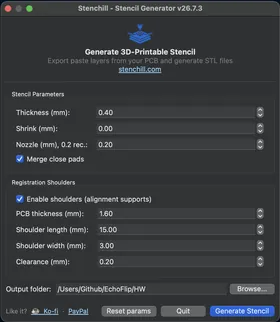
EasyEDA Extension
On EasyEDA Pro? The extension does the same thing from your board, with no Gerber to export by hand.
Learn more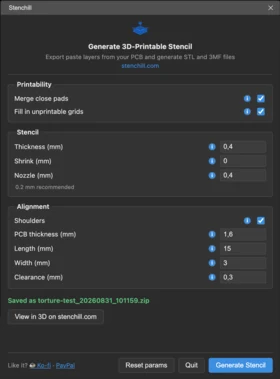
What users think

3D printing tips
Material
PLA or PETGPLA works great, PETG offers slightly more rigidity
Print bed
Smooth surfaceGlass, smooth PEI or mirror gives a flat face that spreads paste cleanly
Nozzle
0.2 mmRecommended for best results. A 0.4 mm nozzle is still acceptable
Layer height
0.1 mmEssential for a smooth surface and good paste application
Stencil thickness
0.3 - 0.4 mm3 to 4 layers at 0.1 mm. Thinner = less paste, thicker = more deposit
Infill
100%Full infill ensures stencil rigidity
Wall generator
ArachneVariable-width walls for narrow pad openings
Print speed
30 - 40 mm/sSlow speeds give cleaner pad edges and avoid skipped fine features
Recent stencils
Previews recently published by users of the website. Plugin generations aren't included.


